
From A Distance: Virtual Learning in Arkansas Continues Postpandemic Boom with Some New Features
Aug 1, 2025
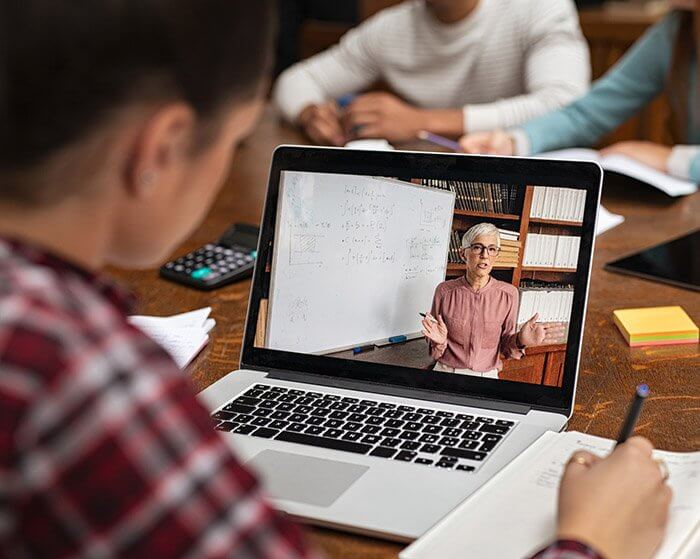
As an undergraduate, Tyler Knight learned how to tiptoe through online learning.
“I did one online course when I was an undergrad,” said Knight, co-director of Harding University in Searcy’s northern European study-abroad programs. “It was, ‘Hey, read this, and then post your thoughts,’ and that kind of was it.”
It has been a while since online coursework was something new. Starting in very rudimentary form in the 1980s, online learning exploded near the turn of the century as colleges and universities spearheaded web-based classes as a means of meeting the demands of nontraditional students.
Online classes, at the outset, were a cost-effective way of servicing students who could not attend classes in the traditional sense. Those early days had a bit of a Wild West feel as educational institutions experimented with different online services and formats. The results were mixed. Some courses faithfully replicated the classroom experience, while others operated at a bare-bones minimum that failed to match the rigor of in-person classes.
Saying things have changed since then would be an understatement, and most of that points back to a year when online learning jumped from option to necessity — the onset of the COVID-19 pandemic in 2020.
“It’s really interesting to see the evolution over time,” Knight said. “I started teaching online courses before COVID. Obviously, COVID accelerated the comprehension of what you can accomplish.”
Nowadays, online classes are as much a foundation of two- and four-year colleges as classrooms and dorms. With many institutions of higher learning facing declines in physical enrollment, using the web remains a vital way of attracting tuition dollars.
For those who think there are some subjects that cannot be taught via a screen, think again.
“The newest frontier in online learning is, I would say, augmented reality,” said Jennifer Swartout, associate vice president for general education at NorthWest Arkansas Community College in Bentonville. “For instance, if you are in a nursing-type program or a clinical-type program, virtual reality can create an entire world where you are practicing clinical skills in an environment that mimics a real-life environment, but you’re not going to be hurting anybody by failing.”

Virtual reality has been around in various forms for a while, but marrying it with traditional online learning has proven to be a game changer. Nowhere has that been more true than with two-year colleges, which tend to offer more hands-on classes. While online classes are perfectly fine for, say, learning economics, many vocational classes have not had the same luxury. It is hard to learn how to repair air conditioners, for example, without an actual air conditioner in front of the student. Advances in virtual reality have made that kind of interactive learning more accessible, swinging open doors to enrollment that used to be closed.
Given that so many two-year colleges place an emphasis on career readiness, the days of “easy” online courses are mostly long gone. Rigor is not just a desired outcome — it is vital. Nobody, Swartout said, would offer online classes for something like nursing unless they knew it would stand up to anything also offered in the traditional classroom.
“There are accreditation standards for meaningful interaction online,” Swartout said. “If your interaction as a student is very thin, that’s probably a course that isn’t well designed. In our college, we really have an entire apparatus that we’ve developed over the last couple decades to ensure quality, and then we monitor how classes are designed and how students are interacting.”
Yet, ironically, one of the biggest signs of virtual learning’s surge in Arkansas can be found in a physical building. Headquartered in downtown Little Rock, the Arkansas Virtual Academy functions out of a sweeping, open-plan office floor that looks more like a successful tech startup than a center for K-12 online education. Teachers and administrators work from desks, where they are joined by counselors, special education professionals, testing coordinators and curriculum specialists.
In short, it feels like walking into a recently constructed school — minus the students.
“A lot of people would be surprised, but ARVA started in 2003,” said Amy Johnson, head of school. “Back then, it was still dial-up days, and so everybody was still trying to figure out if this could even be a mode of education.”
Johnson characterized ARVA as being just like any public school in the sense that the faculty and staff are constantly looking to improve the educational process, whether that be through new teaching methods, improved curriculum or better classroom management. It just does not happen with students physically present.
“What’s beautiful about ARVA is because of its virtual nature, we can provide some of those innovative opportunities and really investigate what works and what doesn’t work,” she said.
Johnson echoed her collegiate counterparts when she pointed to the COVID-19 pandemic as a turning point. With virtual learning not just evolving but actually becoming mandatory, the training wheels came off in terms of what can be offered to remote students.
“I think for a lot of people, that’s when the cat came out of the bag,” Johnson said.
Since then, ARVA has ramped up its offerings to students, which now include career coaching, advanced-placement classes and classes that double as college credit. Students take the same standardized tests as their brick-and-mortar counterparts, and the school offers field trips and social opportunities.
“People are surprised that we have building-level principals,” Johnson said. “We have prom and graduation. We have a fall dance for our kids, so there’s a lot of crossover.”
Johnson said there is no single cohort when it comes to the type of student who enters ARVA’s virtual doors. There have been elite-level athletes whose travel and training schedules require a quicker, more open-ended pace, and there have been students who blossom emotionally and academically in a home setting.
“We have sort of that bucket for high-flying kids that have other interests or want to speed up their educational experience,” Johnson said. “We have several students that come to us because they have some sort of emotional issue. They’ve been bullied. They may have extreme anxiety. We also have students that haven’t been successful in a brick-and-mortar setting.”
The arguments against online learning as a permanent K-12 option are many, starting with socialization. Critics claim daily interaction with peers in a physical school is necessary for a student’s mental and emotional well-being. Johnson did not discount that but maintained socialization at a traditional school is not always what it is cracked up to be and that socializing is not a one-size-fits-all proposition anymore.
“One of the things I say a lot is that a K-12 experience shouldn’t just be this right of passage,” Johnson said. “Like, you have to go sit in a classroom for 13 years before you can start your real life. That’s kind of, in some ways, what we’ve made it.”
With 5,500 students representing all 75 Arkansas counties, ARVA’s mission is clearly resonating within the state.
“If I had to summarize all of that into one reason I hear from parents, it’s that they’re looking for something very individualized and very specific for a need their student has,” Johnson said.
Virtual education may not appeal to everyone, but it is not going anywhere. Johnson recently received approval to push ARVA’s enrollment to 7,000, and Swartout predicted the number of NWACC students benefiting from improved virtual reality learning will only grow with time.
“In theory, absolutely,” Swartout said. “We are exploring ways to offer that kind of distance learning to all of our students and in as many programs as possible.”
Online education has evolved, but just like any tool, it still comes down to the person or persons using it.
“I may not be popular for saying this, but it really comes down to the adults,” Knight said. “They’re kind of responsible for the students and their education. Any sort of online platform really comes down to the instructor and how rigorous it is and how well they enforce that rigor.”